TL;DR
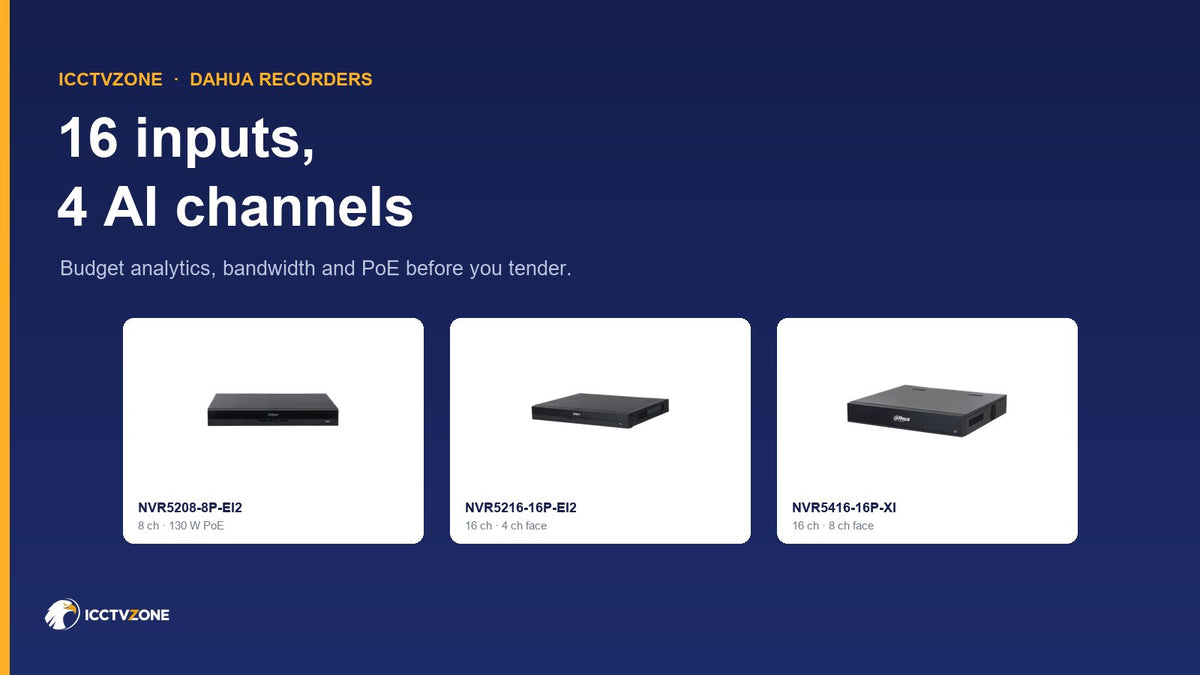
- “16-channel AI NVR” does not mean 16 channels of recorder-side AI. The NVR5216-16P-EI2 runs face detection on 4 channels and metadata on 4; only the NVR5416-16P-XI reaches 8-channel face and 16-channel perimeter.
- Switching AI on cuts ingress bandwidth from 448 to 200 Mbps on the EI2 series — a 55% reduction that must be in the tender, not discovered at commissioning.
- PoE is the quiet constraint: 130 W across 16 ports averages 8.1 W per camera, so a mixed 4 MP and PTZ site runs out before the channel count does.
The short answer
A tender that asks for a “16-channel NVR with AI” can be answered by three very different boxes, and the difference shows up in the channel counts on the AI table, not on the box. Budget those channels first, then the bandwidth, then the PoE watts and disk bays.
The practical rule: count how many cameras need face recognition, metadata or perimeter analytics on the recorder. If that number is above four, the 16-channel WizSense model does not satisfy the tender even though it has sixteen inputs. If the site needs more than 20 TB of usable storage, two bays will not carry it.
This article uses the specification tables of three current recorders to show how to write those numbers into a bill of quantities, with the arithmetic spelled out.
What a tender means by “16-channel AI NVR”
“Channel” is an input count. A 16-channel recorder accepts sixteen camera streams. “AI channel” is a processing count: how many of those streams the recorder itself can analyse at once, at the analytics the customer asked for.
Those two numbers are independent. A recorder can accept sixteen cameras and analyse four of them, and that is exactly what the NVR5216-16P-EI2 does for face detection. Cameras with on-board analytics can cover the rest, but then the analytics live in the camera and the recorder only stores the result — a different architecture with a different failure mode.
So the tender line has to be split into three: inputs, recorder-side AI channels per function, and camera-side analytics. Writing “16 AI channels” without saying which function is how projects end up with a recorder that can watch sixteen doors but only recognise four faces.
The three recorders, side by side
The table below is taken from each product's specification sheet. The two EI2 models share the same processing platform; the XI model is a larger chassis with roughly twice the AI and storage headroom.
| Specification | NVR5208-8P-EI2 | NVR5216-16P-EI2 | NVR5416-16P-XI |
|---|---|---|---|
| Input channels | 8 | 16 | 16 |
| Bandwidth (AI off / on) | 448 / 200 Mbps | 448 / 200 Mbps | 512 / 512 Mbps |
| Max. decoding | 40 × 1080p@30 | 40 × 1080p@30 | 32 × 1080p@30 |
| 8 MP decode (AI off) | 10 channels | 10 channels | 8 channels |
| Face detection by recorder | 4 channels | 4 channels | 8 channels |
| Face database | 30,000 images | 30,000 images | 200,000 images |
| Perimeter by recorder | 8 channels | 8 channels | 16 channels |
| SMD Plus by recorder | 8 channels | 16 channels | 16 channels |
| Metadata / AcuPick by recorder | 4 / 4 channels | 4 / 4 channels | 8 / 16 channels |
| PoE ports and budget | 8 ports, 130 W total | 16 ports, 130 W total | 16 ports, 200 W total |
| Per-port PoE maximum | 25.5 W | 25.5 W | 25.5 W |
| Disk bays and maximum | 2 × 26 TB | 2 × 26 TB | 4 × 20 TB |
| Alarm input / output | 4 / 2 | 4 / 2 | 16 / 6 |
| Chassis and weight | 1U, 2.50 kg | 1U, 2.62 kg | 1.5U, 4.58 kg |
| ONVIF | 25.12, S/G/T/M | 25.12, S/G/T/M | 23.06, S/G/T |
The three models in this comparison are the NVR5208-8P-EI2, the NVR5216-16P-EI2 and the NVR5416-16P-XI. Read the AI rows as the tender rows, because that is where the three diverge most.
Note the asymmetry: input channels double from eight to sixteen between the two EI2 models, but face detection stays at four and metadata stays at four. The 16-channel model buys inputs, not analytics. The XI doubles the analytics and quadruples the face database, at the cost of a larger chassis and a different ONVIF baseline.
Recorder-side AI is measured in channels, not in the box
This is the row that decides most tenders, so it is worth drawing rather than describing.

Two consequences follow. First, a site that wants face recognition at an entrance plus metadata on a vehicle gate can fit inside four channels; a site that wants face recognition at eight doors cannot, and needs the XI or camera-side analytics.
Second, camera-side analytics change the storage and the bandwidth picture, because the camera sends events rather than the recorder computing them. That is often the cheaper path on a brownfield site where the cameras are already WizSense or WizMind, but it moves the single point of failure into each camera.
For the perimeter and SMD rows the gap is narrower: the 16-channel EI2 already covers all sixteen inputs for SMD and eight for perimeter, so a site whose analytics requirement is “person and vehicle filtering everywhere, intrusion on the fence line” can be served by the smaller box. Write that distinction into the tender instead of “AI”.
Bandwidth: what happens when AI is switched on
On both EI2 models the ingress, recording and outgoing bandwidth drop from 448 Mbps to 200 Mbps when AI is enabled. That is the platform reserving capacity for analysis, and it is a 55% cut that most bills of quantities do not mention.
The arithmetic is simple enough to do at tender stage. Sixteen cameras at 4 Mbps need 64 Mbps, which fits inside 200 Mbps with room to spare. At 8 Mbps the same site needs 128 Mbps, still inside. At 12 Mbps it needs 192 Mbps, which fits but leaves 8 Mbps for a second stream, a substream or an operator pulling a recorded clip. At 16 Mbps it needs 256 Mbps and the design fails.
So the practical AI-on ceiling for sixteen cameras is somewhere around 12 Mbps per camera. For 8 MP cameras at 25 fps that is generous; for 12 MP cameras with high-motion scenes it is not, and the tender either drops the frame rate, raises the compression, or moves to the XI platform where 512 Mbps applies with AI on.
Do not size the switch on the AI-off number. A recorder that accepts 448 Mbps today will refuse the same cameras the day someone enables face recognition, and the symptom is dropped frames rather than a clean error.
PoE and storage: the two budgets that decide the model
PoE is where the channel count stops being abstract. Both 16-port EI2 and XI models cap each port at 25.5 W, but the total budget differs: 130 W on the EI2, 200 W on the XI.
Divide the budget by the ports and the average allowance appears. On 130 W across sixteen ports that is 8.1 W per camera. Sixteen cameras drawing 8 W each land at 128 W and fit, with 2 W spare — no margin for a heater or a pan-tilt head. Sixteen cameras at 10 W need 160 W and the design fails, even though every individual port is within its 25.5 W rating.
Mixed sites fail first. A row of 4 MP bullets at 6 W plus two PTZ cameras at 20 W is 136 W, which already exceeds the EI2 budget before cable loss. The XI's 200 W gives 12.5 W average across sixteen ports, which covers the same mix with about 60 W to spare.
Storage follows the same shape. A camera at X Mbps writes about X × 10.8 GB per day, because 1 Mbps for 24 hours is 10.8 GB. Sixteen cameras at 4 Mbps therefore write about 691 GB per day, and thirty days is 20.7 TB. Sixteen cameras at 8 Mbps write 41.5 TB over the same period.

One more arithmetic step makes the table concrete. Take the same sixteen cameras and two bitrates, and put both hardware budgets next to them.
| Design | Ingress (AI on) | 30-day storage | 2-bay RAID 1 (26 TB) | 4-bay RAID 5 (60 TB) |
|---|---|---|---|---|
| 16 × 4 Mbps | 64 Mbps | 20.7 TB | Fits, 5.3 TB spare | Fits comfortably |
| 16 × 8 Mbps | 128 Mbps | 41.5 TB | Does not fit | Fits, 18.5 TB spare |
| 16 × 12 Mbps | 192 Mbps | 62.2 TB | Does not fit | Does not fit |
The 12 Mbps row is the one that catches architects. Bandwidth still fits inside 200 Mbps, but the retention no longer fits the four-bay chassis, so the choice moves from “which recorder” to “which bitrate and how many cameras per recorder”. Both answers belong in the tender.
Now put that against the bays. Two bays of 26 TB give 52 TB raw; in RAID 1 that is 26 TB usable, which holds the 4 Mbps design at 20.7 TB but not the 8 Mbps design at 41.5 TB. Four bays of 20 TB give 80 TB raw; in RAID 5 that is 60 TB usable, which holds both. This is the calculation that turns “16 channels” into a specific model number.
Where each model fails a tender
The 8-channel EI2 fails on input count the moment the site has nine cameras, even if only four need analytics. It is the right box for a shop with six cameras and one entrance, not for a building with sixteen.
The 16-channel EI2 fails on face channels when the tender says face recognition at every door. Four channels of recorder-side face detection do not stretch to eight doors, and the workaround is camera-side analytics or the XI.
The 16-channel EI2 also fails on PoE when the camera mix includes PTZs or heaters, because 130 W across sixteen ports is 8.1 W average.
The XI fails on ONVIF baseline and chassis for projects that mandate Profile M across the estate: the XI lists 23.06 with S/G/T, while the EI2 models list 25.12 with S/G/T/M. It also needs 1.5U of rack space and weighs 4.58 kg.
All three fail if the tender omits the camera bitrate, because bandwidth and storage both hang off a number nobody wrote down. Ask for the design bitrate per camera at the tender stage, not at commissioning.
A tender checklist
Eight lines turn the model choice into something a supplier cannot answer vaguely.
- Input count, and how many cameras need analytics at all.
- Recorder-side AI channels per function: face, metadata, perimeter, SMD.
- Design bitrate per camera, and the resulting ingress at AI on.
- Live-view requirement: how many 8 MP streams on screen at once.
- PoE draw per camera including heaters, and the total against the budget.
- Retention days, compression, and the resulting terabytes with the RAID level.
- Alarm inputs and outputs needed at the recorder, not at the camera.
- ONVIF profile the VMS requires, with the version.
Two related guides cover the numbers behind lines three and six: NVR storage math for retention and RAID, and NVR PoE budget for the watts side of the same design.
Two smaller lines on the same datasheets change what the operator can do at the screen. Multi-screen display is listed as 1, 4, 8, 9 or 16 on the main and sub outputs, and the ONVIF baseline differs between the EI2 and XI models — 25.12 with profiles S, G, T and M against 23.06 with S, G and T. Neither decides a tender on its own, but both surface after handover: an operator who wants a sixteen-way wall on a recorder that decodes eight 8 MP streams will be told to use sub streams, and a VMS that expects profile M behaves differently on the XI.
Write those two lines next to the AI channels in the bill of quantities. The tender then describes the operating experience rather than only the recording capacity, and the acceptance test has something concrete to check beyond “it records”.
Products in this comparison
Current listing prices; stock and lead time are confirmed before dispatch.


FAQ
Does a 16-channel NVR give 16 channels of AI? No. AI channels are a processing count. The NVR5216-16P-EI2 accepts sixteen inputs but runs face detection on four and metadata on four; perimeter reaches eight and SMD reaches sixteen.
What happens to bandwidth when AI is enabled? On the EI2 series it drops from 448 to 200 Mbps for incoming, recording and outgoing. The platform reserves the difference for analysis, so the design must be sized on the AI-on figure.
Can sixteen 8 MP cameras run on the 130 W PoE budget? Only if they average 8.1 W each. Sixteen at 8 W fit with 2 W spare; sixteen at 10 W need 160 W and do not fit.
How much storage do sixteen cameras need for thirty days? At 4 Mbps it is about 20.7 TB; at 8 Mbps it is about 41.5 TB. That is 16 × bitrate × 10.8 GB per day × 30 days.
Do two bays carry thirty days of 8 MP recording? Not at 8 Mbps. Two bays of 26 TB give 26 TB usable in RAID 1, which is below the 41.5 TB requirement; four bays of 20 TB give 60 TB usable in RAID 5 and do carry it.
Which model handles face recognition at eight doors? The NVR5416-16P-XI, which lists eight channels of recorder-side face detection and a 200,000-image database. The EI2 models stop at four channels and 30,000 images.
Can I mix camera-side and recorder-side analytics? Yes, and it is common. Cameras run the analytics and send events; the recorder stores and correlates. Confirm which side owns each rule, because that decides what happens when a recorder is replaced.
Sources and method
Channel counts, bandwidth, decoding, PoE budgets, disk bays and weights come from the specification tables published for each model on our product pages, which reproduce the manufacturer's sheets. Manufacturer documentation is at Dahua Security, and profile definitions at ONVIF.
Storage arithmetic: 1 Mbps sustained for 24 hours is 10.8 GB, so daily gigabytes equal bitrate × 10.8. Bandwidth totals are simple sums of per-camera bitrate. PoE averages divide the stated total budget by the port count. Usable capacity assumes RAID 1 for two bays and RAID 5 for four bays, with no hot spare.
These are design calculations on published specifications, not measurements of a specific site. Confirm the final numbers against the datasheet revision that ships with the order, and re-check the AI-on bandwidth after any camera change.