TL;DR
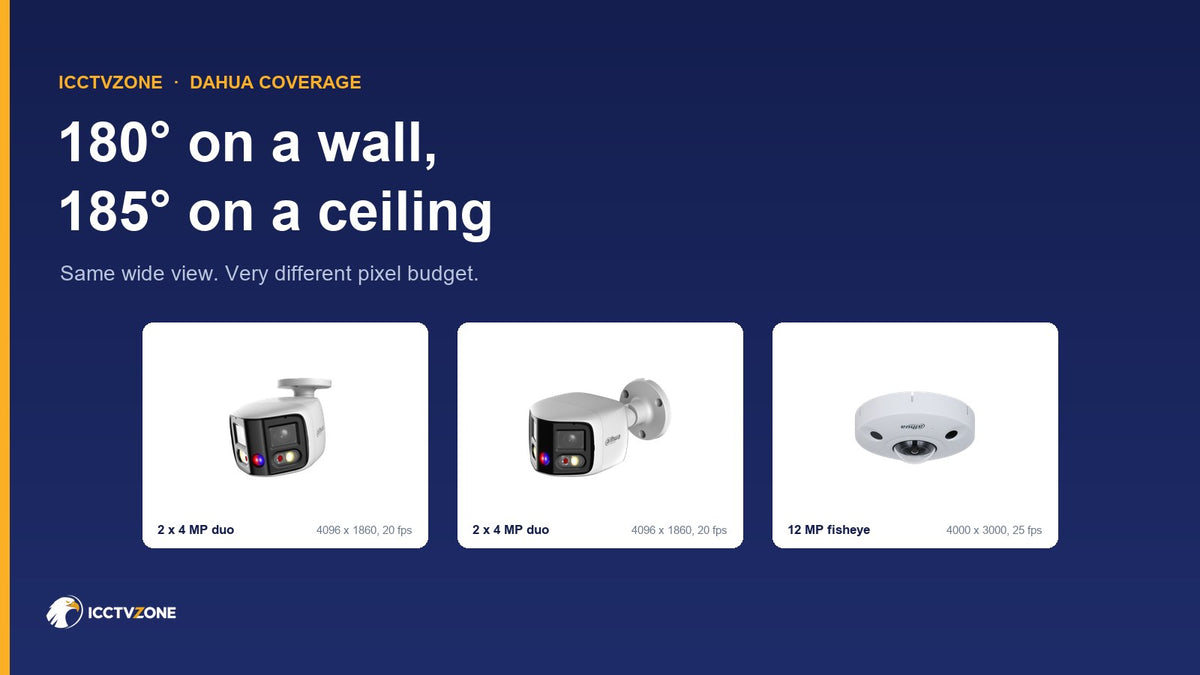
- A wall-mounted 180° duo keeps about 21.6 vertical pixels per degree; a 12 MP ceiling fisheye keeps about 16.7 across a 180° vertical view.
- On the datasheets that works out to identification at 5.1 m for the duo and 4.0 m for the fisheye — the camera with more megapixels identifies from closer, not farther.
- Choose by mounting surface and night reach: wall, 25 m IR and PoE 802.3af for the duo; ceiling, one 185° view, PoE+ and a 10 m IR limit for the fisheye.
The short answer
If the camera will hang on a wall, a pole or the outside corner of a building and must watch a yard, a driveway or a service entrance, the 180° duo is the safer order. If it will hang from a ceiling and must cover a whole room from one position — a lobby, a shop floor, a corridor junction — the fisheye does a job the duo cannot do at all.
The two products are not two versions of one idea. One stitches two rectilinear views into a wide panorama; the other bends a single 185° image and relies on software to flatten it. That difference decides the mounting surface, the night range and the switch in the bill of materials.
Everything below comes from the datasheet tables published for the three models compared here, plus arithmetic you can repeat on a calculator. Where a number is my calculation rather than a printed specification, the text says so.
Why “180°” is not one specification
When buyers compare a 180 degree camera vs fisheye, the headline number hides three separate facts: horizontal field of view, vertical field of view, and how the wide image is produced. A horizontal 180° with 86° vertical is a wide letterbox. A horizontal 185° with 180° vertical is a hemisphere. Both are marketed as panoramic, and neither is a substitute for the other.
The duo reaches its 180° with two 1/2.7" CMOS sensors, each behind a 2.8 mm F1.4 lens, and outputs one stitched 4096 × 1860 frame at up to 20 fps. The join happens inside the camera, so the seam is the manufacturer's problem; the near field is not, because close focus is 0.8 m.
The fisheye uses one 1/1.7" 12 MP sensor behind a 1.85 mm F2.0 lens, outputs 4000 × 3000 at up to 25 fps, and offers the usual dewarp layouts: 1O, 1P, 2P, 1R, 2R, 4R and 1O + 3R. Those layouts are produced by the camera, the recorder or the client, not by the lens alone, so the picture you finally watch depends on what is downstream.
A 4R or 2P view is only useful if the device that displays it supports the mode, so ask for the dewarp list of the NVR or VMS as well as the camera. Profile support belongs in the ONVIF conformance documents, not in a datasheet line item.
What the three datasheets actually claim
The eyeball and the bullet are the same camera in two housings. Sensor, lens, field of view, intelligence and DORI table are identical; power draw, dimensions and weight differ slightly. Treat them as one optical decision and a separate mechanical one.
| Specification | IPC-PDW3849-A180-AS-PV (eyeball) | IPC-PFW3849S-A180-AS-PV (bullet) | IPC-EBW81242-AS-S2 (fisheye) |
|---|---|---|---|
| Image sensor | Dual 1/2.7" CMOS (2 × 4 MP) | Dual 1/2.7" CMOS (2 × 4 MP) | 1/1.7" CMOS (12 MP) |
| Max. resolution and frame rate | 4096 × 1860 at 20 fps | 4096 × 1860 at 20 fps | 4000 × 3000 at 25 fps |
| Lens | 2.8 mm fixed, F1.4 | 2.8 mm fixed, F1.4 | 1.85 mm fixed, F2.0 |
| Field of view (H × V) | 180° × 86° | 180° × 86° | 185° × 180° |
| Close focus distance | 0.8 m | 0.8 m | 0.4 m |
| Illumination | IR to 25 m, warm light to 20 m | IR to 25 m, warm light to 20 m | IR to 10 m (3 LEDs) |
| Wide dynamic range | 120 dB WDR | 120 dB WDR | DWDR |
| Minimum illumination | 0.005 lux colour at F1.4 | 0.005 lux colour at F1.4 | 0.01 lux colour at F2.0 |
| Alarm and audio | 1 in / 1 out, audio in/out, dual mic, speaker | 1 in / 1 out, audio in/out, dual mic, speaker | 2 in / 2 out, audio in/out, built-in mic |
| Network port | 10/100 Base-T | 10/100 Base-T | 10/100/1000 Base-T |
| Power and maximum draw | 12 V DC / PoE 802.3af, 10.85 W max | 12 V DC / PoE 802.3af, 10.3 W max | 12 V DC / PoE+, 13.9 W max |
| Protection | IP67 | IP67 | IP67, IK10 |
| Weight | 990 g | 695 g | 790 g |
| DORI: identify | 5.1 m | 5.1 m | 4.0 m |
These are the three models in this comparison: the IPC-PDW3849-A180-AS-PV eyeball, the IPC-PFW3849S-A180-AS-PV bullet and the IPC-EBW81242-AS-S2 fisheye. Read each table against the same three questions, because the marketing summary is shorter than the table it sits above.
The first surprise is the frame shape. The duo is described as 2 × 4 MP, yet it delivers 4096 × 1860 — 1,860 vertical lines, less than half the 4,000 lines the 12 MP fisheye produces. For identification work the vertical count matters more than the marketing class, because a standing person is a tall object in a wide frame.
Recompute the pixel budget for your scene
Field of view and resolution are enough to estimate whether a person is identifiable at a given distance, and the arithmetic is short. Divide vertical pixels by vertical field of view to get pixels per degree. Then compute the angle a target subtends and multiply.
For a standing adult, the vertical extent is roughly 1.8 m. The subtended angle is 2 × arctan(0.9 ÷ distance). At 6 m that is 17.06°, so the duo puts about 369 pixels on the person (17.06 × 21.63) and the fisheye about 284 pixels (17.06 × 16.67). Same scene, same distance, 23% less detail from the camera with the larger sensor.

| Camera | Vertical pixels per degree | 450 px on a person | 350 px | 250 px | Datasheet identify |
|---|---|---|---|---|---|
| 180° duo (either housing) | 21.63 | 4.9 m | 6.3 m | 8.9 m | 5.1 m |
| 12 MP fisheye | 16.67 | 3.8 m | 4.9 m | 6.8 m | 4.0 m |
The calculation is worth doing because it validates the datasheet instead of trusting it. At the duo's printed identify distance of 5.1 m a 1.8 m person subtends 20.0°, which is 433 pixels; at the fisheye's 4.0 m the same person subtends 25.4°, which is 423 pixels. Both land within 5% of 450 pixels, or 250 pixels per metre of target.
That consistency is the useful part: both datasheets were built on the same criterion, so 5.1 m and 4.0 m can be compared directly. It also pins down what “identify” means here — about 425 to 450 pixels on a standing adult, centre of frame, in good light.
Two caveats keep the estimate honest: a fisheye distributes pixels unevenly, so a person near the frame edge measures worse than the table, and none of it survives a dirty dome or a badly aimed lens.
Wall geometry and ceiling geometry behave differently
A wall camera looks sideways; a ceiling fisheye looks down. That sounds obvious until you draw the vertical field and see what each one can and cannot see.

Mount the duo at 3 m with its axis horizontal and its lower edge sits 43° below the axis. That edge meets the ground at 3 ÷ tan 43°, about 3.2 m from the wall. The strip between the wall and that point is outside the picture, which is exactly where a vehicle nose, a bin or a person crouching will be. The fix is mechanical — tilt the camera down, or move it — not optical.
The fisheye at the same 3 m on a ceiling sees the floor from directly below outward in every direction, because its vertical field is 180°. Nothing under the camera is hidden. That is the reason fisheye units survive in retail aisles and lobbies where wall positions do not exist.
The cost appears as foreshortening. Put a person 3 m out from the point below a 3 m ceiling: the slant range is 3.66 m and the camera looks down at them at about 35°. Their 1.8 m height projects to roughly 1.47 m in the image, and at 261 pixels per metre at that range they measure about 385 pixels. The duo at the same 3.66 m slant range measures about 597 pixels, because it looks at them side-on. Same distance, 36% less detail — the geometry did that, not the sensor.
So the specification question is not “which view is wider” but “where can the camera physically go, and what does it look at from there”. A 185° hemisphere from a ceiling beats a 180° half-circle from a wall in a room with no usable wall; in a yard the reverse holds, because there is no ceiling to hang from.
Power, WDR and night range change the bill of materials
Power is where the fisheye quietly changes the switch order. Its maximum draw is 13.9 W on PoE, and 802.3af only guarantees 12.95 W at the powered device. The duo's 10.85 W fits inside that envelope; the fisheye does not, so the port must be 802.3at or the camera must run on 12 V DC. Specifying PoE+ on the quote costs less than discovering it during commissioning.
The fisheye also lists 3 W of heating on top of its imaging draw, which matters in cold sites and should sit in the port budget rather than inside it.
Dynamic range is the second bill-of-materials issue. The duo carries 120 dB WDR; the fisheye carries DWDR, a digital treatment that is not the same thing. For a fisheye staring at a glazed entrance with daylight behind arriving visitors, that difference decides whether faces survive the exposure. The duo also has the faster lens at F1.4 against F2.0 and the lower minimum illumination, 0.005 lux against 0.01 lux, which compounds at night.
Frame rate is the third. Twenty frames per second on a 180° device is adequate for walking pace and marginal for a running subject; the fisheye offers 25. In a loading bay with forklifts, plan shutter and frame rate before the lens.
Where each camera fails
The duo fails at the wall. A 180° horizontal view from a wall cannot see behind itself, and its 86° vertical view cannot see the ground at its own base.
The duo fails at long identification. Beyond about 5 m a face is no longer reliable, and beyond 20 m even observation stretches the datasheet's own numbers.
The fisheye fails in backlight. DWDR is not 120 dB WDR, and a fisheye is usually aimed at exactly the worst contrast in the room: a bright door or window with a darker interior.
The fisheye fails at night beyond 10 m. Its IR reach is 10 m, and at that distance a 1.8 m person measures about 171 pixels — enough to see that someone is there, not enough to identify them.
The fisheye fails without dewarp support. If the recorder or VMS cannot produce a usable 1P or 4R view, the operator gets a distorted circle and stops using the camera. Confirm the viewing mode on the actual platform, not in the demo.
Both fail on the recorder side if the stream is not supported. A 4096 × 1860 stream at 20 fps and a 4000 × 3000 stream at 25 fps both need a channel that accepts them. Check the recorder's resolution and decoding budget, and whether your network recorders support the dewarp and profile you are buying.
A specification checklist to send with your RFQ
A written specification removes most of the ambiguity in this decision. Send these eight lines and require a written answer against each one.
- Mounting surface and height: wall, pole or ceiling, and the measured height to the lens or dome.
- Required identification distance and the width that must be covered at that distance.
- The pixel count per target your customer will accept — 450, 350 or 250 pixels on a standing adult.
- Worst-case lighting: backlit entrance, full dark, or mixed, with the illuminator distance required.
- Night requirement beyond the camera's own IR reach: none, warm light, or separate lighting.
- Recorder model, supported resolutions, dewarp modes and PoE class per port.
- Switch budget in watts with an allowance for heating, not only imaging draw.
- Acceptance test: who stands where, at what distance, and what counts as a pass.
Add the mechanical line items early. The eyeball is 990 g and 135 mm deep, the bullet 695 g and 183 mm long, the fisheye 790 g and 60 mm deep — different brackets, and in the fisheye's case an IK10 housing that a weak ceiling plate can defeat.
Pricing should follow the specification, not lead it. The fisheye generally costs more per unit, and the extra money buys geometry, not identification distance. Where the site has a ceiling and no wall that is a fair trade; where it has a wall and a 5 m identification requirement, the fisheye buys nothing and costs a PoE+ port.
FAQ
Is a 180° camera the same as a fisheye camera? No. The duo stitches two 2.8 mm views into a 180° × 86° panorama; the fisheye bends one 1.85 mm lens into a 185° × 180° hemisphere and needs dewarp to be readable. They share a marketing word, not an optical design.
Why does the 12 MP camera identify from closer than the 8 MP one? Because identification depends on pixels per degree, not total pixels. The fisheye spreads its 3,000 vertical pixels across 180°, giving 16.67 per degree; the duo concentrates 1,860 pixels across 86°, giving 21.63.
Can I use the duo indoors on a ceiling? Only if you accept that its 86° vertical view cannot see the floor near the mount. A ceiling mount with a horizontal axis leaves a blind strip of roughly 3.2 m at a 3 m height, and tilting down costs horizontal coverage.
Does the fisheye need a special recorder? It needs a recorder or VMS that can decode 4000 × 3000 and produce the dewarp layout your operators will use. Confirm the specific modes on the platform, not only on the camera datasheet.
How much PoE headroom should I plan for? Use the maximum draw, not the basic draw. That is 10.85 W for the eyeball, 10.3 W for the bullet and 13.9 W for the fisheye, before cable loss and before any heating allowance.
Which one is better for a parking area? The duo, on a wall or pole, because the night range is 25 m with IR and 20 m with warm light. A fisheye only makes sense there with a mast or canopy to hang it from.
What should I check on site before accepting either camera? Have a person stand at the approved identification distance in daylight and after dark, confirm the detail at the recorder rather than in a browser, and confirm the dewarp or panorama view on the operator's own screen.
Related reading: Dahua WITHS Guide to Wi-Fi, 4G and Solar Security Cameras and Dahua Camera Substitutions. Each covers a step that decides what this one assumes.
Sources and method
The optical, power and DORI figures come from the datasheet tables published for each model on our product pages, which reproduce the manufacturer's specification sheets. Manufacturer documentation is available at Dahua Security, and profile conformance for third-party integration is published by ONVIF.
Pixels per degree is vertical pixels divided by vertical field of view. The angle a target subtends is 2 × arctan(half height ÷ distance), with a target height of 1.8 m; the distances for 450, 350 and 250 pixels are that formula inverted. The foreshortening example assumes a 3 m ceiling, a subject 3 m from the point below the camera and a subject centre 0.9 m above the floor.
No figure here is a laboratory measurement. They are arithmetic on published specifications, offered so a quotation can be checked before an order. Confirm the final numbers against the datasheet revision that ships with your order, and record the acceptance test on site.