TL;DR
- Three Dahua bullets share the same 8 MP 1/1.8" sensor yet differ in aperture (F1.0 vs F1.6), IR reach (80 m vs 50 m), maximum PoE draw (24.2 W vs 15.1 W) and alarm contact type (dry vs wet).
- The F1.0 models collect about 2.56× the light of the F1.6 model at the same scene, and the 24.2 W model leaves only 1.3 W of headroom inside the 802.3at budget.
- A substitution is only safe when six checks pass in writing: optics, night reach, power, wiring, platform and on-site acceptance.
The short answer
A model suffix is a promise about a specification, not a cosmetic detail. When a supplier offers a substitute, the question is not whether the new part number looks close; it is which of the six numbers below changed and whether the installation still passes its acceptance test.
Three current 8 MP Dahua bullets make the point better than any rule. They share the same sensor format and output resolution, and they would look interchangeable on a one-line quotation. In the datasheets they differ in aperture, IR distance, maximum power draw, alarm contact type and stream count — every one of which can fail a project after delivery.
This article walks the three models through a substitution check you can run in a meeting, with arithmetic you can repeat. It is not a claim that the models are interchangeable with a firmware setting.
Three cameras that look identical on a quote
All three are 3840 × 2160 cameras on a 1/1.8" CMOS sensor, all take 2.8 mm and 3.6 mm fixed lenses at the same field of view, and all list the same DORI detection and observation distances at 2.8 mm. A buyer comparing only resolution, sensor size and field of view would see one product.
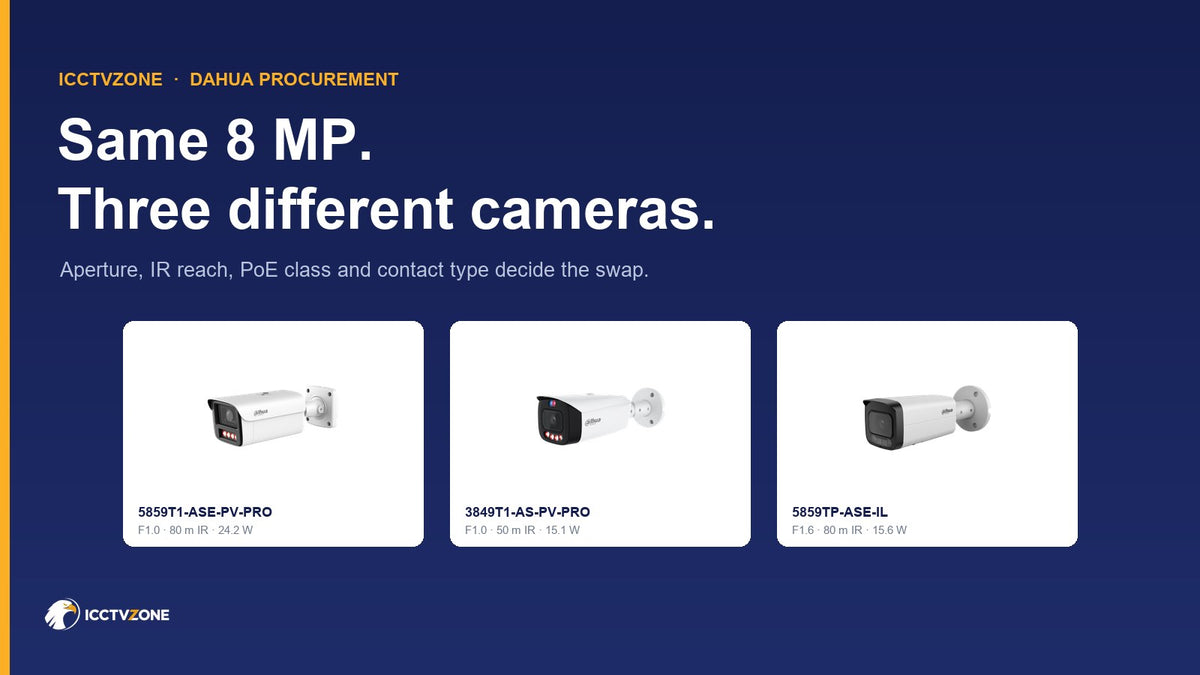
The IPC-HFW5859T1-ASE-PV-PRO is the active-deterrence model: F1.0, 80 m IR, 60 m warm light, 24.2 W maximum on PoE, IP67 and IK10. The IPC-HFW3849T1-AS-PV-PRO keeps the F1.0 lens but halves the illumination to 50 m IR and 50 m warm light, drops the maximum draw to 15.1 W, and lists IP67 only. The IPC-HFW5859TP-ASE-IL adds a 6 mm lens option, returns to 80 m IR and 60 m warm light, but uses an F1.6 lens and keeps the draw at 15.6 W.
Read the suffixes as a reading aid for these three tables, not as a universal key: the letters track the light and deterrence hardware, the product tier and the lens, while the digit blocks track the model family and generation. The lens option is also carried in the order code, which is why -0280 and -0360 exist as separate SKUs on the same model.
What each suffix actually changes
The table below is the whole argument. Every row is a number a project manager can be held to, and every difference is taken from the specification table published for that model rather than inferred from the name.
| Specification | 5859T1-ASE-PV-PRO | 3849T1-AS-PV-PRO | 5859TP-ASE-IL |
|---|---|---|---|
| Sensor and resolution | 1/1.8", 3840 × 2160 | 1/1.8", 3840 × 2160 | 1/1.8", 3840 × 2160 |
| Maximum aperture | F1.0 | F1.0 | F1.6 |
| Lens options | 2.8, 3.6 mm | 2.8, 3.6 mm | 2.8, 3.6, 6 mm |
| Field of view at 2.8 mm | 109° × 59° | 109° × 59° | 110° × 56° |
| Close focus at 2.8 mm | not listed | 3.2 m | 2.1 m |
| IR and warm light | 80 m / 60 m | 50 m / 50 m | 80 m / 60 m |
| Wide dynamic range | 130 dB | 120 dB | 120 dB |
| Minimum illumination | 0.0004 lux at F1.0 | 0.0008 lux at F1.0 | 0.0008 lux at F1.6 |
| Identify distance at 2.8 mm | 8.2 m | 8.2 m | 8.9 m |
| Alarm output contact | Dry contact | Wet, 300 mA 12 V DC | Wet, 300 mA 12 V DC |
| Audio | Dual mic, speaker, two-way talk | Dual mic, speaker, two-way talk | Built-in mic, sound warning |
| Streams and ONVIF profile | 4 streams, S / G / T / M | 3 streams, S / G / T | 4 streams, S / G / T / M |
| Micro SD maximum | 1 TB | 512 GB | 1 TB |
| Power inputs | 12 V DC, PoE+, ePoE | 12 V DC, PoE+ | 12 V DC, PoE+, ePoE |
| Maximum draw on PoE | 24.2 W | 15.1 W | 15.6 W |
| Protection and weight | IP67, IK10 | IP67, 1.0 kg | IP67, IK10, 835 g |
Two rows deserve emphasis because they are the ones buyers miss. The alarm output on the 5859T1 is a dry contact; on the other two it is a wet contact rated 300 mA at 12 V DC. Those are not interchangeable at the terminal strip: a dry contact switches a circuit you supply, a wet contact supplies 12 V itself. Changing models can mean changing the relay or the power supply feeding the gate or strobe.
The audio row decides whether a speaker-based talk-down still works. Two models list a dual microphone and a speaker with two-way talk; the third lists a built-in microphone and a sound-warning function with 11 alarms and 10 custom sounds, but no speaker or two-way talk. If the site greets visitors through the camera, that is a functional loss, not a spec detail.
The arithmetic behind the swap
Two numbers explain most of the practical difference between these models, and both are simple enough to check in a meeting.

Light gathering scales with the inverse square of the F-number. Comparing F1.0 with F1.6 gives (1.6 ÷ 1.0)² = 2.56, so at the same scene illuminance the F1.0 models put about 2.56× the light on the sensor. The datasheets are consistent with that: the F1.0 models quote 0.0008 lux or better for colour, while the F1.6 model quotes 0.0008 lux at its own aperture, and the 5859T1 reaches 0.0004 lux at F1.0.
Power is the harder constraint because it is shared. 802.3at guarantees 25.5 W at the powered device. The 5859T1 takes 24.2 W at maximum, which leaves 1.3 W — about 5% — for cable loss and tolerance. The other two take 15.1 W and 15.6 W, leaving 10.4 W and 9.9 W.
That difference decides how many cameras a switch can carry. On a 240 W PoE+ budget, 24.2 W allows nine cameras at maximum draw (240 ÷ 24.2 = 9.9), while 15.1 W allows fifteen (240 ÷ 15.1 = 15.9). Maximum draw is transient — it happens with IR, warm light, deterrence and analytics running together — but a switch is sized on the number that can occur, not the number that usually occurs.
A twelve-camera yard shows how quickly that bites. Twelve of the 24.2 W model need 290 W at maximum, which exceeds a 240 W switch before cable loss is counted; twelve of the 15.6 W model need 187 W and fit with margin. The lighting upgrade is real, but it is a switch upgrade too, and the second invoice rarely appears in the comparison that started the substitution.
Identification distance also moves, though less than buyers expect. The 5859TP identifies at 8.9 m against 8.2 m for the two F1.0 models, because its vertical field of view is 56° rather than 59°: 2,160 pixels spread over a narrower angle give a slightly higher angular resolution. The 6 mm lens version pushes identification to 14.0 m. If a substitution changes the lens, the field of view and the identification distance change with it, and that is a design decision.
Long cable runs add a fourth variable. The 5859T1 and the 5859TP list ePoE alongside PoE+, while the 3849T1 lists 12 V DC and PoE+ only. Where an existing run is already stretched beyond standard Ethernet distance, that line in the datasheet can decide the substitution on its own, before anyone compares image quality.
A substitution gate you can run in a meeting
Six checks, in this order, turn a vague “it is basically the same camera” into an approval with evidence. Run them against the two datasheets and write the answer for each.

Optics. Confirm focal length, aperture and field of view. A lens change alters both coverage and identification distance, and the 2.8 mm and 3.6 mm variants of the same model are different order codes for that reason.
Night reach. Compare IR and warm-light distances to the distance you actually need lit, not to the site boundary. A 50 m camera on a 60 m yard is a known gap before installation.
Power. Compare maximum draw with the PoE class the switch port can deliver, and re-count cameras per switch. A model that needs 24.2 W will not fit where a 15 W model was budgeted.
Wiring. Compare alarm input and output contact types and ratings. Dry and wet contacts are not interchangeable, and a relay that worked with one will not necessarily work with the other.
Platform. Compare stream count and ONVIF profiles against what the recorder and VMS actually use. Profile M carries metadata and analytics; a camera without it changes what the VMS can consume even if the video looks the same.
Acceptance. Re-run the site test at the installed distance, at night, on the recorder, with the alarm path triggered. This is the only gate that proves the substitution, and it is the one most often skipped when the deadline is close.
Where a substitution must be refused
The same six gates produce hard stops, not discussion points. These are the cases where a substitution should be refused unless the project scope is formally changed.
| The change | What it does to the site | Why the swap stops |
|---|---|---|
| Lens changes without approval | Field of view, close focus and identification distance all move | A -0360 part is not a -0280 part with a note |
| Draw rises to 24.2 W on a tight switch | Cameras brown out under full IR, light and analytics | Symptom is random reboots, not a clean failure |
| Wet contact replaced by dry contact | Gate or strobe has no supply at the terminal | Existing wiring was sized for a supplied 12 V output |
| Dry contact replaced by wet contact | A circuit designed to be isolated gets 12 V imposed | Back-feed risk on the external load |
| Speaker model replaced by mic-only model | Talk-down is lost, sound warning remains | Two-way talk was in the scope, not an extra |
| Profile M dropped from the bill | VMS metadata and analytics degrade quietly | Video looks fine, which hides the loss |
| No night test after the swap | Failure is discovered by the customer | An unverified substitution is a guess with a PO attached |
FAQ
Can I swap a 2.8 mm model for a 3.6 mm model of the same family? Only with the field of view written down and accepted. At 2.8 mm the view is 109° × 59°; at 3.6 mm it narrows to 93° × 50°, and the identification distance rises from 8.2 m to 10.0 m. That is a different camera for the site even though the model family matches.
Is a higher F-number always worse at night? At the same scene and sensor, yes: F1.6 collects about 39% of the light that F1.0 collects. Whether that matters depends on how much light the site has and whether the IR or warm light is doing the work.
Why does the F1.6 model identify slightly farther? Because its vertical field of view is 56° instead of 59°. Fewer degrees across the same 2,160 vertical pixels means more pixels per degree, which buys about 0.7 m of identification distance.
Can the 24.2 W model run on an 802.3af switch? No. 802.3af guarantees 12.95 W at the powered device, far below 24.2 W. The camera needs 802.3at, or the 12 V DC input.
Does a dry alarm contact need an external power supply? Yes. A dry contact only closes a circuit; the voltage and current for the load come from whatever supply you wire through it. The wet contact on the other two models supplies up to 300 mA at 12 V DC directly.
Which model should replace a failed 50 m IR camera? Either 80 m model clears the night-reach gate, but they differ downstream: the F1.0 model costs 9.1 W more at maximum draw and brings a dry contact, while the F1.6 model keeps the power budget and the wet contact but halves the light gathering. Match the choice to the switch and the wiring you already have.
What evidence should a supplier give for a substitution? The datasheet pages for the offered model, the changed rows highlighted, and a written statement of the lens, power class, contact type and ONVIF profiles. Anything less leaves the acceptance test as the only protection.
Related reading: Dahua Camera WDR: Fix Backlight Without Washing Out and Dahua Camera Bitrate. Each covers a step that decides what this one assumes.
Sources and method
Every specification in this article comes from the datasheet tables published for the three models on our product pages, which reproduce the manufacturer's specification sheets. Manufacturer documentation is available at Dahua Security; interoperability profiles are published by ONVIF. The DORI tables in those datasheets cite EN-62676-4 as their reference for detect, observe, recognise and identify distances.
The light comparison is illuminance proportional to 1 ÷ F², normalised to F1.6. The switch example divides a 240 W PoE budget by each model's datasheet maximum draw and rounds down to whole cameras. The identification distances quoted are the datasheet DORI values, not site measurements.
No figure here is a laboratory measurement of these cameras. They are arithmetic on published specifications, offered so that a substitution can be checked before it is ordered. Confirm the final numbers against the datasheet revision that ships with your order, and record the acceptance test on site.