Dahua's press release for DSS V8.8 lists fourteen features in nine hundred words and leaves the two questions an integrator actually has unanswered: what does this change on a Monday morning, and what has to be tested before anyone signs off. This is the working version of that release.
The short story: Dahua has split its VMS line into a clear ladder, put a 300,000-channel ceiling at the top, moved the client into the browser, and turned the lightweight OneBox into something that can join a larger system instead of sitting beside it. The details below are the ones that decide whether an upgrade is a two-hour job or a two-week one.
TL;DR
- DSS Ultimate is new: 300,000 channels, and it absorbs access control, parking, incident response and traffic into one platform.
- Web client everywhere — Chrome, Firefox, Safari and Edge, no install. This is the change most installers will notice first.
- OneBox goes from 16 to 64 access channels and gains ONVIF plus HIK encoder support, so it can front existing hardware.
- Text-defined alarms and multilingual WizSeek move rule authoring from engineers to operators — which is a governance change, not just a feature.
Recommended Dahua network recorders
A rotating selection from our current stock. Availability and pricing are confirmed at checkout.


Check stock or request a quote
Enter a Dahua part number to see live availability, or send it straight to our team for a price and lead time.
What DSS actually is, and where the tiers sit
DSS is Dahua's on-premise security management platform, distinct from the DMSS phone app and from the recorder's own web interface. It runs on customer servers, manages cameras and recorders across sites, and adds the functions a control room needs: maps, alarm handling, access control, parking, attendance and reporting.
Three names get confused constantly, and the difference decides who you are quoting. DMSS is the phone and tablet app for a single recorder or camera. SmartPSS is the free desktop client for one site — a few recorders, one building. DSS is the server-based platform: multiple sites, users, roles, maps, alarms and, from V8.8, access control and parking. If a customer asks for "the Dahua software", the first question is whether anyone else needs to log in; if the answer is yes, the conversation is about DSS.
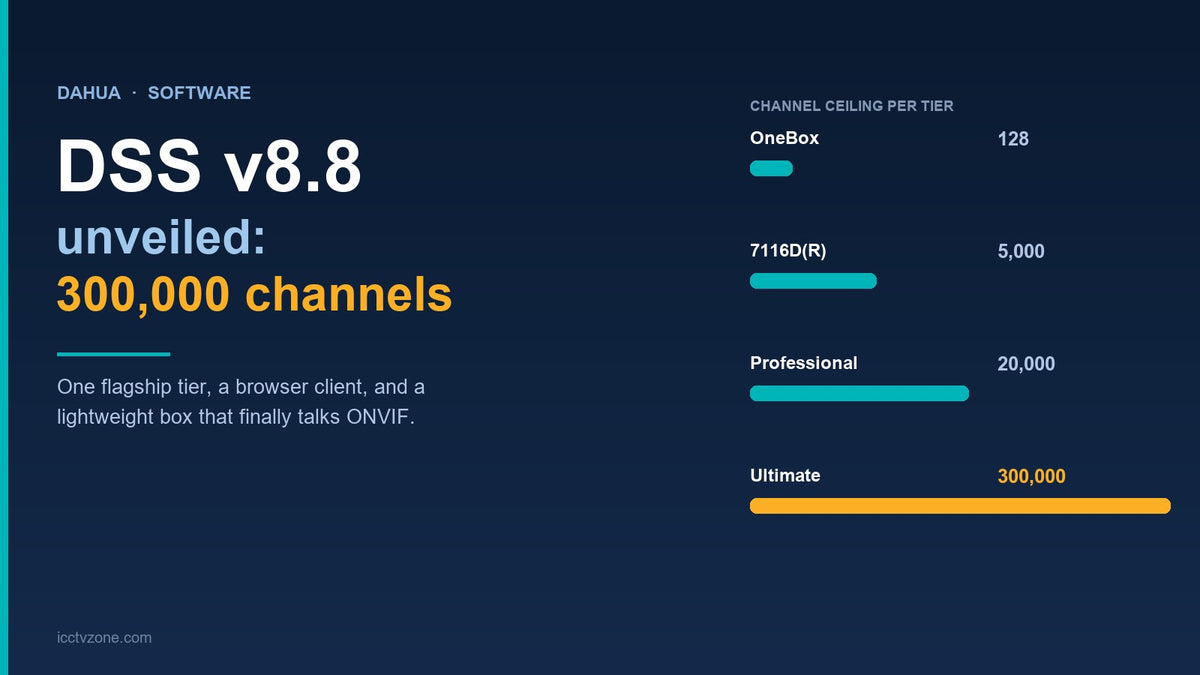
Dahua publishes the channel ceiling for each tier. The ladder matters more than any single number, because it tells you which product a project will land on before a single quote is written.
| Tier | Channel ceiling | Deployment shape | Fits |
|---|---|---|---|
| DSS OneBox | 128 | Single server, desktop workstation | One building, one shop, one small campus |
| DSS 7116D(R) | 5,000 | All-in-one appliance | Mid-size enterprise with a fixed footprint |
| DSS Professional | 20,000 | Multi-server, multi-site | Distributed estates, city sub-systems |
| DSS Ultimate | 300,000 | Clustered, mission-critical | National or metro-scale operations |
Dahua's own figures put the installed base at 50,000+ project sites, 150,000+ activated license keys and 150+ countries. That is the context for the 300,000-channel figure: it is a platform number that already has 20,000-channel and 5,000-channel siblings below it, not a claim that any single box records 300,000 streams.
What 300,000 channels really means
Run the arithmetic and the point becomes clear. At 2 Mbps per channel, 300,000 cameras is 600 Gbps of aggregate stream. At 4 Mbps it is 1.2 Tbps. Storage at 2 Mbps continuous is 21.6 GB per channel per day, so 300,000 channels would write 6.48 PB in a single day.
No server rack does that. The 300,000 number is a management plane ceiling: how many devices, sites, users and events one platform can coordinate. Video is still recorded at the edge, on recorders and storage arrays, and the platform orchestrates access to it.
| If you assume | 300,000 channels would need | What it means for design |
|---|---|---|
| 2 Mbps, continuous | 600 Gbps, 6.48 PB/day | Recording stays distributed; the platform does not carry media |
| Sub-stream preview at 0.5 Mbps | 150 Gbps of live viewing | Still needs a viewing cluster, not one workstation |
| 1,000 operators online | Session and role load, not bandwidth | Plan identity and roles before servers |
DSS Ultimate: what the top tier adds
Ultimate is positioned as "all DSS Pro capabilities, plus" — so an existing Pro deployment is the natural comparison point, not a greenfield system.
One platform for security and operations. Access control, parking, incident response and traffic management sit inside the same interface as video. In practice this removes the integration work that used to sit between a VMS, an access control server and a parking controller — and it moves the failure surface into one vendor's stack, which is a trade worth making explicitly rather than by default.
Command Center (CAD + EMS). The release describes a closed loop: multi-source alarm intake, visual dispatch, and evidence handling with chain-of-custody expectations. This is the part that changes a control room's process. Computer-aided dispatch and an evidence management system are workflow products; they will be judged on how fast an operator can go from alarm to dispatched resource to archived evidence, not on how many features the menu has.
Traffic Center. Dahua states 32 vehicle violation types, 22 road incident types, and real-time plus historical flow monitoring. Those numbers are worth reading as a scope statement: it is a city-traffic product, not a feature for a shopping mall car park.
What every tier gets in V8.8
Web client. Login from Chrome, Firefox, Safari and Edge with no client install. For installers this is the single biggest operational change: no more "which version of the desktop client is on the operator's laptop". The caveat is codec and browser behaviour — H.265 playback in a browser still depends on the browser build and hardware, so test the actual operator machines rather than the demo laptop.
OnePass app. The former VDP Agile app has been renamed and extended with personal attendance: mobile check-in and attendance queries, with automatic detection of valid check-in ranges. That last part is the useful bit for sites with large perimeters — it removes the guesswork about whether an employee was inside the geofence.
Attendance and parking. Six attendance rule configurations and 36 report templates, editable and exportable. Parking adds multiple charging strategies with self-service and manual payment — the manual mode is what keeps a barrier moving when the payment path is down.
In-vehicle monitoring. Real-time driving monitoring, trip recording and archiving, and multi-dimensional operational analysis for fleet use. This extends DSS from fixed surveillance into mobile assets without a separate platform.
Text-defined alarms. Operators can describe a rule in natural language and deploy it. It is genuinely faster than navigating a rule builder, and it is also the feature most likely to create alarm noise. Treat it as a privilege to be governed: who can publish a text rule, how it is tested, and how it is retired.
WizSeek multilingual. Image search by text description, extended to major minor languages. If your site indexes footage from multiple language regions, plan for a rebuild of the search index after upgrading, not just an application update.
Stackable licensing and language packages. Formal and trial licenses can be stacked, so a customer can trial an unlicensed function at lower cost. The language architecture is decoupled, so new languages arrive as patch packages instead of a full release. Both reduce friction; both need a budget owner, because trial licences that become permanent are a cost that appears after signature.

DSS OneBox: the quiet upgrade that matters for SMB
Three changes turn OneBox from a standalone viewer into a system component.
Access channels: 16 to 64. Four times the door count on the same lightweight workstation. That moves OneBox from "one office door" to "a small building with parking and a reception turnstile" without jumping to Professional.
ONVIF and HIK encoder support. This is the interoperability line that matters during a takeover: an existing analogue encoder plant does not have to be ripped out on day one. It also means a mixed-brand site can be brought under one interface before any hardware refresh is approved.
Remote-site mode. OneBox can register to DSS Professional or Ultimate as a remote site, and it gains IP speaker support, video tracking, an operations center, domain user management, intelligent search and event statistics. For multi-site operators this is the difference between a central platform that sees four sites and one that sees every site, including the small ones that never justified a server.
Licensing: the four questions to settle first
Every DSS tier is licensed by channel, and V8.8 adds both stackable trial licences and decoupled language packages. Those two changes sound like plumbing and are actually the ones that move a budget.
Ask four things before a quote goes out. One: is the channel count licensed by camera, by device, or by stream — the answer changes the number when a recorder carries sixteen channels. Two: what happens when a trial licence expires on a function the site has started using daily. Three: are language packages included in support, or a separate line item each time a new site opens. Four: does the licence follow the hardware if the server is replaced mid-term.
None of these is a trick question, but each one has been the difference between a project that renews and one that argues about a surprise invoice twelve months later. Put the answers in writing next to the channel count, not in a footnote.
What to test before you upgrade
An upgrade plan that only lists features is a sales document. This is the list that decides whether the cutover holds.
| Area | What to verify | Why it fails silently |
|---|---|---|
| Licence migration | Old keys import, stacked trial keys expire as expected | Features look enabled during the trial window |
| Browser playback | Chrome, Edge, Safari, Firefox on the actual operator hardware | Desktop client worked; the browser build cannot decode H.265 |
| Alarm rules | Re-test every rule, especially text-defined ones | A reworded rule still fires, but on the wrong object class |
| Search index | Multilingual WizSeek returns results in each target language | Index rebuild lags; results look empty for days |
| OneBox as remote site | Registration, live view and event forwarding to the centre | Local view is fine; the centre shows a stale device list |
| Encoders | ONVIF and HIK channels connect, record and play back | Discovery succeeds, recording does not |
| Access and parking | Door count above 16, payment fallback to manual | Barrier stays closed when the payment path is offline |
| Roles and audit | Who can publish text rules, who can export evidence | Everyone can, until someone asks who did |
A phased cutover that does not take the control room offline
The lowest-risk path is not a weekend migration. Register one site — ideally the smallest — and run it in parallel for a week. Operators use the web client for live view while the old client stays available for configuration. Alarm rules are re-created and compared side by side, and the export path for evidence is tested end to end before any real incident depends on it.
Only after that week does the second site move, and only after the second does the licence conversion happen. This order matters: converting licences first means every rollback requires vendor involvement; migrating sites first means a rollback is a configuration change you can do yourself at 2 a.m.
Who should upgrade, and who should wait
Upgrade if you run a control room that fights with desktop client versions, you are consolidating small sites that never justified a server, or you need access control and parking inside one interface rather than beside it.
Wait if your site is stable, single-server, and the operator team is small. The browser client is pleasant, but it does not by itself justify a migration weekend on a system that is already working. Schedule it with the next hardware refresh instead.
Plan carefully if you rely on text-defined alarms or multilingual search. Both change how people work, and both need an owner after go-live — the features are easy to switch on and easy to leave unowned.
FAQ
Is DSS Ultimate a separate product or a licence level?It is a separate product in the DSS family, listed alongside Professional, OneBox and 7116D(R), with its own 300,000-channel ceiling.
Does the web client replace the desktop client?It removes the install step for day-to-day access. Keep the desktop client available for configuration work and for machines where browser decoding is limited.
Can OneBox really join a DSS Ultimate system?Yes — Dahua states it can act as a remote site connected to Professional or Ultimate, and gains the associated features in that mode.
Do I need new cameras to use OneBox's ONVIF support?No. The point is to bring ONVIF and HIK encoders under the same interface, which is what makes a staged takeover possible.
What does "stackable licensing" mean for budgeting?Formal and trial licences can be combined, so a function can be evaluated before it is purchased. Budget for the conversion, not just the trial.
Is 300,000 channels realistic for one customer?It is a platform ceiling for federated deployments. Individual recorders and storage still carry the media, and network design decides the real limit.
What breaks first in an upgrade?Licences and browser playback, in that order. Both are cheap to test and expensive to discover after cutover.
Sources
- Dahua press release: DSS V8.8, 21 April 2026 — Ultimate tier, Command Center, Traffic Center, full-series changes, OneBox upgrades.
- DSS Ultimate product page — positioning and platform scope.
- Explore DSS — tier channel ceilings (128 / 5,000 / 20,000 / 300,000) and module list.
If you are specifying DSS for a project, the recorder and camera layer still decides what the platform can show you. Our network recorder range and network camera range list the models that pair with the current firmware families, and the PTZ range covers the tracking hardware that makes a Command Center deployment worth building.
Tell us the site count, channel count and whether access control is in scope — we will confirm which DSS tier fits and what hardware has to match it.