TL;DR
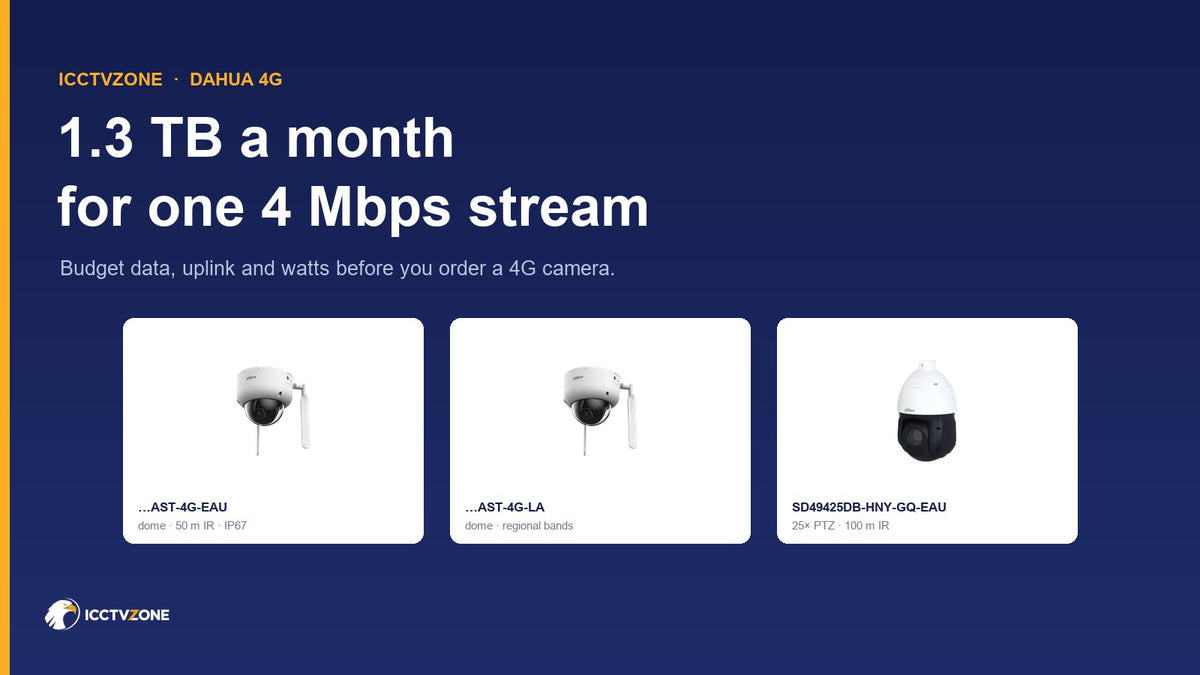
- A continuous 4 Mbps stream costs about 1.8 GB per hour, 43 GB per day and 1.3 TB per month — a 20 GB SIM allowance covers roughly eleven hours.
- Event-driven recording at 20% duty cuts the same month to about 260 GB, which is the difference between a viable 4G project and one that runs out of data in week one.
- The PTZ draws up to 15.49 W with IR, PTZ and streaming together, against 4.54 W when it streams without its illuminator; off-grid sites must budget the maximum.
The short answer
A 4G camera quotation tells you the camera. It does not tell you the monthly data bill, the band your local operator uses, or what happens to the uplink when the pan-tilt head moves and the illuminator comes on at the same time.
Those three items decide whether the project works. Budget them before ordering: the data rate you will actually run, the duty cycle of the recording, and the power budget if the site has no mains.
This article uses the specification tables of three 4G models to put numbers on each, with the arithmetic shown so it can be re-run for a different site.
What “4G camera” leaves out of the quotation
“Supports 4G” is a capability line, not a design. The PTZ in this comparison lists its bands explicitly: LTE-TDD band 38 and 40, LTE-FDD bands 1, 3, 5, 7, 8, 20 and 28, WCDMA 1, 5 and 8, and GSM 850, 900 and 1800. That set covers Europe, much of Africa and Asia and the common Latin American bands, and it is why the same camera ships in an -EAU and an -LA variant.
Confirm the band against the operator's own coverage map before the order, not after installation. A camera that supports LTE but not the band the tower serves behaves exactly like a camera with no SIM.
The second omission is the SIM itself: whether the plan is metered, throttled after a cap, or blocked for high usage. The third is the uplink capacity at the site, which decides the maximum bitrate the camera can hold.
The three models in this comparison
Two fixed domes and one PTZ. The domes are the same camera in two regional band variants; the PTZ is the model that publishes the full radio and power detail.
| Specification | IPC-HDBW3441DR1-AST-4G-EAU | IPC-HDBW3441DR1-AST-4G-LA | SD49425DB-HNY-GQ-EAU |
|---|---|---|---|
| Sensor and resolution | 1/2.7", 4 MP 2688 × 1520 | 1/2.7", 4 MP 2688 × 1520 | 1/2.8", 4 MP 2560 × 1440 |
| Lens | Fixed focal | Fixed focal | 5–125 mm, 25× zoom, F1.6–F3.6 |
| IR distance | 50 m | 50 m | 100 m |
| Bitrate range | not listed | not listed | 2,816–13,056 kbps (H.264) |
| Streams | not listed | not listed | 3 (4M / D1 / 720p) |
| 4G bands | not listed (EAU variant) | not listed (LA variant) | TDD 38/40; FDD 1/3/5/7/8/20/28 |
| Micro SD | up to 256 GB | up to 256 GB | up to 512 GB |
| Audio | Mic + speaker, two-way talk | Mic + speaker, two-way talk | 1 in / 1 out |
| Alarm I/O | 2 in / 2 out | 2 in / 2 out | 2 in / 1 out |
| Power consumption | 12 V DC, 165 mA max output | 12 V DC, 165 mA max output | 3.75–15.49 W depending on mode |
| Protection | IP67, IK10 | IP67, IK10 | IP66, TVS 6000 V |
| Weight | not listed | not listed | 2.6 kg |
The three models are the IPC-HDBW3441DR1-AST-4G-EAU dome, its -LA variant and the SD49425DB-HNY-GQ-EAU PTZ. The blanks in the dome columns are real: the published listing gives the radio family only through the model suffix, so the band table has to come from the supplier or the operator.
Read the table as a warning about quotation habits. The two domes and the PTZ share a resolution class, yet only one of them publishes a bitrate range, a stream layout and a power table. Those are exactly the numbers a 4G project needs.
Data budget: from Mbps to gigabytes
Video data is easy to compute once the rate is fixed. One Mbps sustained for an hour is 450 MB, because 1 Mbps is 0.125 MB per second and an hour is 3,600 seconds. Everything else follows by multiplication.
| Stream rate | Per hour | 24/7 per day | 24/7 per 30 days | 20% duty, 30 days |
|---|---|---|---|---|
| 1 Mbps | 0.45 GB | 10.8 GB | 324 GB | 65 GB |
| 2 Mbps | 0.9 GB | 21.6 GB | 648 GB | 130 GB |
| 4 Mbps | 1.8 GB | 43.2 GB | 1.30 TB | 259 GB |
| 8 Mbps | 3.6 GB | 86.4 GB | 2.59 TB | 518 GB |
| 13 Mbps (PTZ max) | 5.85 GB | 140 GB | 4.21 TB | 842 GB |
The table answers the question that kills 4G projects: what does a 20 GB monthly allowance buy? At 4 Mbps continuous it buys about eleven hours — 20 GB divided by 1.8 GB per hour. At 1 Mbps it buys 44 hours. Neither is a month, which is why a 4G camera is normally configured to record locally to the SD card and upload only events and short clips.
The duty-cycle column is the useful one. A camera that streams continuously at 4 Mbps costs 1.3 TB a month; the same camera recording to SD and uploading 20% of the day costs 259 GB. The design decision is therefore not “which codec” but “what fraction of the day leaves the site”.

SD retention decides how much the radio must carry
The local card is what makes a 4G camera affordable, so its retention has to be part of the same budget. At 4 Mbps a camera writes 43.2 GB per day, which means a 256 GB card holds about 5.9 days and a 512 GB card about 11.9 days. At 2 Mbps the same cards hold roughly twice as long.
That number sets the upload policy. If the card holds six days, the site can survive a four-day outage without losing the record, and the radio only has to carry events. If the card holds two days, the design has no margin and the operator will be tempted to stream continuously, which is exactly what the data plan cannot afford.
The two domes accept cards up to 256 GB and the PTZ up to 512 GB, so on identical bitrates the PTZ carries twice the local buffer. For a site with unreliable power or a weak uplink, that difference is worth more than a resolution step.
Plan the retention first, then the upload policy, then the SIM allowance. Doing it in the other order produces a data plan that looks affordable and a site that overwrites its own evidence within a week.
Uplink, not downlink, is the constraint
Mobile networks are asymmetric. The camera uploads, and upload capacity at the cell edge is the number that matters, not the headline download speed.
The PTZ publishes a bitrate ceiling of 13,056 kbps and a floor of 2,816 kbps in H.264. A site that cannot sustain roughly 3 Mbps of uplink will not hold even the floor setting when the scene is busy, and the symptom is not a clean failure: frames arrive late, the recorder shows a gap, and the operator blames the camera.
A practical sequence is to test the uplink at the actual mounting position before ordering the SIM plan, set the main stream to a rate the link can hold with margin, and use the sub-stream for live viewing on a phone. The PTZ's three-stream layout makes that possible; the domes' stream layout is not published, so confirm it on site.
Power budget on sites without mains
The PTZ's power table is unusually explicit and it is the right model for any off-grid design. Deep sleep is 0.05 W, basic with no stream is 3.75 W, streaming without the illuminator is 4.54 W, illuminator with no stream is 7.98 W, illuminator plus stream is 8.77 W, and the maximum with illuminator, PTZ movement and streaming together is 15.49 W.
The number to size a battery or solar panel on is 15.49 W, not 4.54 W. A design built on the streaming figure will fail the first night the illuminator comes on while the head is touring, and it will fail worst in winter when the panel output is lowest.

A 12 V 7 Ah battery holds about 84 Wh in theory and considerably less in practice; at 15.49 W that is roughly five hours of maximum load, which is why these sites are usually sized in days of autonomy with a panel, not hours on a battery. The same arithmetic at 4.54 W gives more than eighteen hours, which is exactly how a design ends up three times too small.
Where each model fails
The domes fail on documentation. Their listings do not publish a bitrate range, a stream layout or a power table, so the data and power budgets have to be confirmed with the supplier before the order rather than calculated from the sheet.
The domes fail in wind and at height as a mechanical matter, not a radio one: IP67 and IK10 suit a wall at three metres, not a mast that moves.
The PTZ fails on uplink at the edge of coverage. Its 13 Mbps ceiling is a specification, not a promise the cell will carry it; the same model on a weak link needs the bitrate pinned low and the frame rate reduced.
The PTZ fails on power at off-grid sites if the design uses the streaming figure. Budget 15.49 W and the battery or panel requirement roughly triples.
All three fail if the band is not checked. An -EAU unit on a Latin American operator, or the reverse, is a camera that appears to have no service.
A checklist for the RFQ
Seven lines, written into the enquiry, remove most of the surprises.
- Country and operator, plus the specific LTE bands the tower serves.
- SIM plan: monthly allowance, throttling rule, whether the plan permits continuous video.
- Design bitrate and duty cycle, with the resulting monthly gigabytes.
- Local recording: SD card size and retention at that bitrate.
- Uplink measured at the mounting position, with the margin you will accept.
- Power source and the maximum consumption, not the streaming figure.
- Who owns the SIM, the plan and the replacement process.
The bitrate mechanics behind line three are covered in main stream, sub stream and ROI, and the remote-viewing setup in P2P remote access without opening ports.
Add one commercial line that is easy to forget: who owns the SIM. When the integrator supplies the card, the customer discovers the monthly cost at the first renewal and the project is renegotiated. When the customer supplies it, the integrator cannot test the link before handover. Write the answer down, together with the replacement process for a failed card, because a 4G site with a dead SIM is indistinguishable from a site with no power.
Card class matters as much as card size here. A 256 GB card rated for dashcams or surveillance is built for continuous rewriting; a cheap card of the same capacity will fail inside a year on a camera that records around the clock. Since the whole 4G design leans on local recording, the card is a component with an endurance rating rather than an accessory, and it deserves a line in the bill of materials.
The recording schedule and the data plan are the same decision seen twice. A camera set to continuous on the card and event-only on the radio keeps the full local record and uploads what matters; a camera set to motion on both saves capacity and risks the one quiet event the site actually needed. Write the split down: what the card keeps, what the radio carries, and which events trigger the upload.
One more number from the dome datasheet matters on site: its 12 V output is rated for a maximum current of 165 mA with a peak of 700 mA. That is enough to power a small sensor or a relay board, and it is not enough for a second camera or a heater. Treat the output as a signalling convenience and keep anything larger on its own supply.
Products in this comparison
Current listing prices; stock and lead time are confirmed before dispatch.


FAQ
How much data does a 4G camera use per month? At 4 Mbps continuous it is about 1.3 TB; at 2 Mbps about 648 GB; at 1 Mbps about 324 GB. Those are 24/7 figures — with event-driven upload at 20% duty the same month is roughly one fifth.
Can a 20 GB SIM run a 4G camera? Only with local recording and event upload. At 4 Mbps continuous, 20 GB is about eleven hours of video.
Do the two dome models work on the same networks? They are regional variants of one camera. The EAU and LA suffixes point at different band sets, so confirm the bands against the operator rather than assuming interchangeability.
What bitrate can the PTZ hold on 4G? The camera supports 2,816–13,056 kbps, but the link decides. Test the uplink at the mounting position and set the stream to a rate the link holds with margin.
How much power does the PTZ need off-grid? Budget 15.49 W at maximum — illuminator, PTZ movement and streaming together. Streaming alone is 4.54 W, which is why designs sized on that figure fail at night.
Is local SD recording still needed with 4G? For any realistic data plan, yes. The card holds the continuous record; the radio carries events and clips.
What should I measure on site before ordering? Uplink throughput at the mounting position, the operator band and signal level, and the power available at the pole. Everything else can be decided from the datasheet.
Sources and method
Bands, bitrate range, stream layout, power consumption, storage and protection ratings come from the specification tables published for each model on our product pages, which reproduce the manufacturer's sheets. Manufacturer documentation is at Dahua Security; interoperability profiles are published by ONVIF.
Data arithmetic: 1 Mbps sustained equals 0.125 MB/s, so one hour is 450 MB and one day is 10.8 GB. The duty-cycle column multiplies the 24/7 figure by 0.2. Battery hours divide usable watt-hours by the load in watts. Where a model's listing does not publish a value, the table says “not listed” rather than substituting a sibling model's figure.
These are design calculations, not measurements at a specific site. Signal, uplink and power must be measured on site before the order is placed.